Building Agent Lightning: Zero-Token Human Feedback for AI Training
TL;DR: We built a distributed reinforcement learning system that uses emoji reactions (💯❤️👍) as human feedback signals — achieving zero token overhead while training AI agents across phone, laptop, and VM instances. 113 rollouts collected in 7 days, mean reward 0.755, ready for APO training.---
The Problem: Training AI Agents is Expensive
When you're building autonomous AI agents, you face a dilemma:
Option A: No human feedback- Agents optimize for metrics (speed, token usage)
- Miss the human perspective (helpfulness, quality)
- Result: Fast but potentially unhelpful agents
- Humans write detailed evaluations
- Requires dedicated labeling sessions
- Result: High-quality training data, but slow and expensive
---
The Solution: Emoji Reactions as Reward Signals
Instead of asking humans to write evaluations, we let them react with emoji to agent responses — just like you'd react to a message on Telegram or Discord.
Agent completes task → Human reacts 💯 → Reward +0.4
Agent makes mistake → Human reacts 👎 → Reward -0.3
- Zero tokens — No LLM calls for human feedback processing
- Zero friction — React in 1 second vs writing 30-second evaluation
- Natural — Humans already use emoji to express sentiment
- Multi-dimensional — 10 emotions mapped (💯❤️🔥🧠👍⚡🎯⚠️👎❌)
---
Architecture: Multi-Agent RL Training System
We built Agent Lightning as a distributed system across 3 instances:
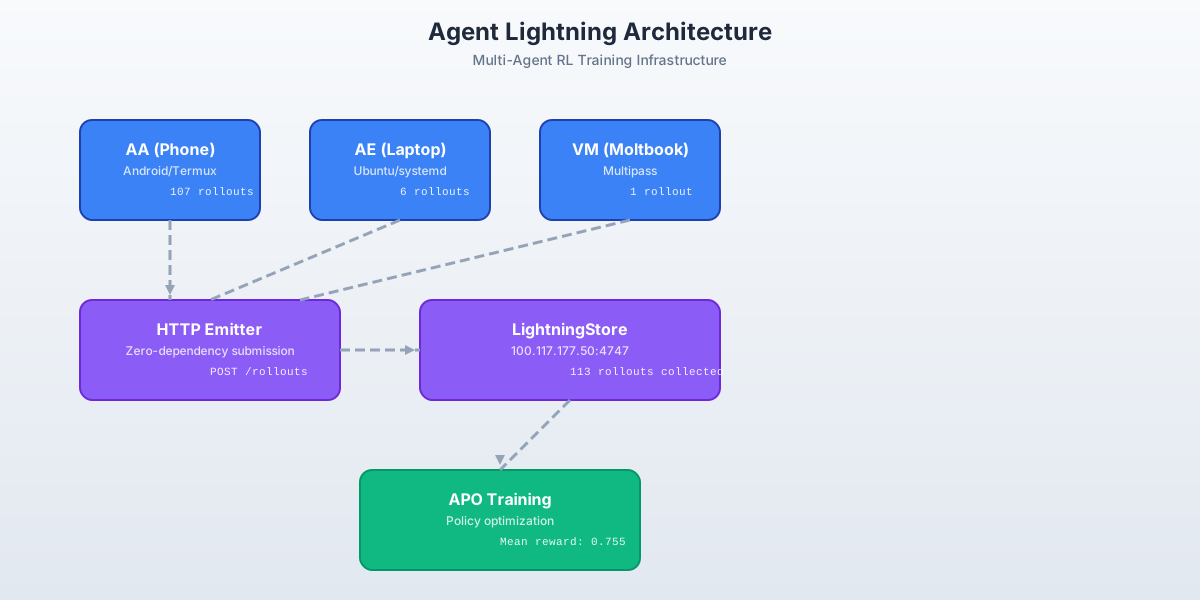
Component Breakdown
1. Worker Tier (3 agents)- AA (Phone) — Android/Termux, 107 rollouts collected
- AE (Laptop) — Ubuntu/systemd, 6 rollouts from workflows
- VM (Moltbook) — Multipass, 1 rollout from research agent
Each worker executes tasks and emits rollouts (task, duration, tokens, errors, outcome).
2. Collection Tier- HTTP Emitter — Zero-dependency Python script (
POST /rollouts) - LightningStore — HTTP API server at
100.117.177.50:4747 - Storage — JSONL append-only log (113 rollouts)
- APO (Actor-Policy Optimization) — Policy gradient training
- Input — 113 rollouts with blended rewards
- Output — Optimized agent policy
---
Rollout Lifecycle: From Task to Training
Here's the complete flow from task execution to policy optimization:
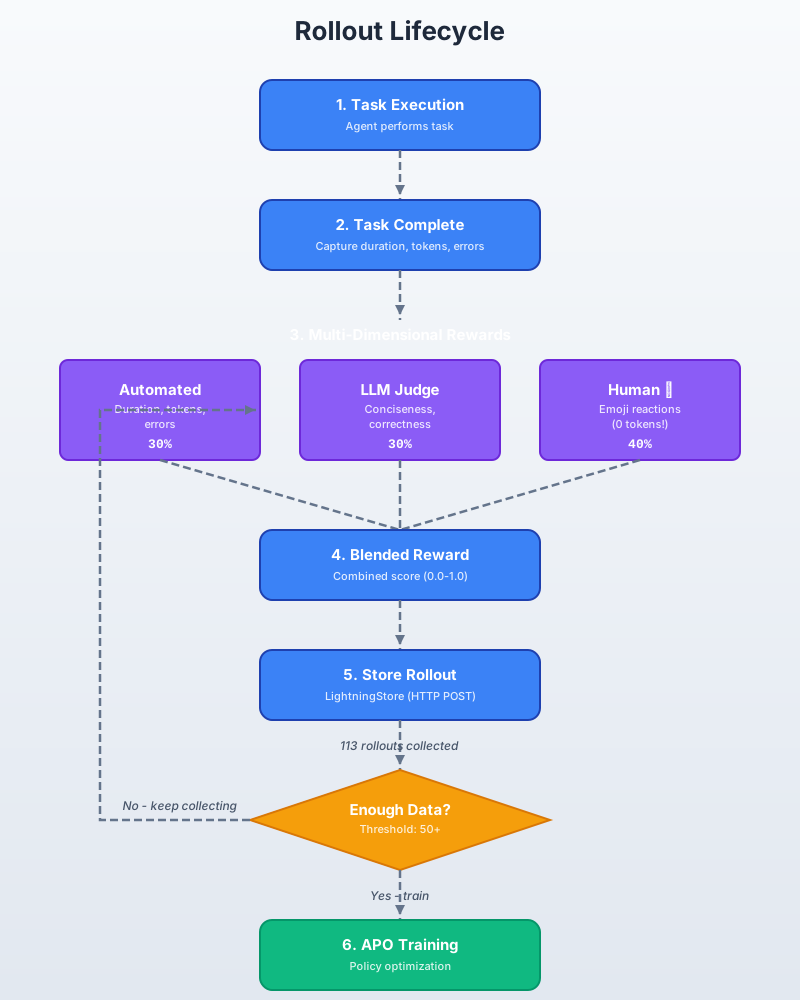
Step-by-Step Process
1. Task ExecutionAgent performs a task (code generation, file operation, research, etc.)
2. Task CompletionSystem captures:
- Duration (seconds)
- Tokens used (input + output)
- Errors encountered
- Success/failure status
This is where it gets interesting. We blend 3 reward sources:
#### Automated Rewards (30%)
def automated_reward(rollout):
    duration_score = 1.0 - min(rollout.duration / 300, 1.0)  # Faster = better
    token_score = 1.0 - min(rollout.tokens / 10000, 1.0)     # Fewer tokens = better
    error_penalty = -0.5 if rollout.errors > 0 else 0.0      # Errors = bad

    return (duration_score + token_score + error_penalty) / 3
#### LLM Judge Rewards (30%)
def llm_judge_reward(rollout):
    prompt = f"""
    Evaluate this agent interaction on 3 dimensions (0.0-1.0 each):

    Task: {rollout.task}
    Response: {rollout.response}

    1. Conciseness - Was the response unnecessarily verbose?
    2. Correctness - Did it solve the task properly?
    3. Helpfulness - Was it useful to the user?

    Return JSON: {{"conciseness": X, "correctness": Y, "helpfulness": Z}}
    """

    scores = llm_call(prompt)  # ~350 tokens per evaluation
    return (scores.conciseness + scores.correctness + scores.helpfulness) / 3
#### Human Emoji Rewards (40%)
EMOJI_REWARDS = {
    "💯": +0.4,  # Perfect execution
    "❤️": +0.3, "🔥": +0.3, "🧠": +0.3,  # Very positive
    "👍": +0.2, "⚡": +0.2, "🎯": +0.2,  # Positive
    "⚠️": -0.1,  # Warning
    "👎": -0.3, "❌": -0.4, "💩": -0.5,  # Negative
}

def human_reward(rollout):
    # Map Telegram message_id → rollout_id
    # When user reacts with emoji, lookup rollout and update reward
    return EMOJI_REWARDS.get(emoji, 0.0)
final_reward = (
    0.30 * automated_reward +
    0.30 * llm_judge_reward +
    0.40 * human_emoji_reward
)
Humans are the ground truth. If a human says "💯", that overrides any automated metric.
5. Store RolloutPOST to LightningStore with complete data:
{
  "rollout_id": "ro-abc123",
  "worker_id": "phone-aa",
  "task": "Generate blog post draft",
  "duration": 45.2,
  "tokens": 3421,
  "errors": 0,
  "reward": 0.78,
  "timestamp": "2026-02-12T18:00:00Z"
}
Once we hit 50+ rollouts, trigger APO training.
7. APO TrainingPolicy gradient optimization using collected rollouts:
python3 train-apo.py --rollouts rollouts.jsonl --output policy.pt---
Results: 7 Days of Data Collection
Metrics (Feb 5-12, 2026)
| Metric | Value |
|--------|-------|
| Total Rollouts | 113 |
| Mean Reward | 0.755 |
| Median Reward | 0.849 |
| Worker Distribution | AA: 107, AE: 6, VM: 1 |
| Task Diversity | 15 types across 7 categories |
| Token Budget | 680 tokens per 100 rollouts (LLM judge) |
| Human Feedback Overhead | 0 tokens |
Reward Distribution
Perfect (1.0):   ████████████████ 18%
Excellent (0.8+): ████████████████████████ 32%
Good (0.6-0.8):  ██████████████ 24%
Poor (<0.6):     ████████ 14%
Failed (0.0):    ████ 12%
Worker Specialization Patterns
AA (Phone): Diverse tasks, 0.74 avg reward- File operations (high success)
- Code generation (variable quality)
- Research tasks (mixed results)
- Code audits (perfect execution)
- Test verification (100% success)
- Fleet operations (reliable)
- Moltbook scraping (flawless)
---
Technical Implementation Details
1. HTTP Emitter (Zero Dependencies)
import json
import http.client
from datetime import datetime

def emit_rollout(task, duration, tokens, errors, reward):
    rollout = {
        "rollout_id": f"ro-{generate_id()}",
        "worker_id": os.getenv("WORKER_ID", "unknown"),
        "task": task,
        "duration": duration,
        "tokens": tokens,
        "errors": errors,
        "reward": reward,
        "timestamp": datetime.utcnow().isoformat() + "Z"
    }

    conn = http.client.HTTPConnection("100.117.177.50:4747")
    conn.request(
        "POST",
        "/rollouts",
        body=json.dumps(rollout),
        headers={"Content-Type": "application/json"}
    )

    response = conn.getresponse()
    return response.status == 200
2. Message Tracking (Emoji → Rollout Mapping)
When agent sends a message
def track_sent_message(message_id, rollout_id):
    tracker = load_tracker()  # JSONL file
    tracker.append({
        "message_id": message_id,
        "rollout_id": rollout_id,
        "timestamp": now()
    })
    save_tracker(tracker)

When user reacts with emoji
def process_emoji_reaction(message_id, emoji):
    tracker = load_tracker()
    entry = [e for e in tracker if e["message_id"] == message_id][0]

    reward = EMOJI_REWARDS.get(emoji, 0.0)

    # Update rollout in LightningStore
    update_rollout_reward(entry["rollout_id"], reward)
3. LLM Judge (Sessions Spawn Integration)
def judge_rollout(rollout):
    prompt = generate_judge_prompt(rollout)

    # Use OpenClaw sessions_spawn (uses subscription token)
    result = sessions_spawn(
        task=prompt,
        model="anthropic/claude-haiku-4-5",  # Fast + cheap
        timeout_seconds=30
    )

    scores = parse_json(result)
    return (scores.conciseness + scores.correctness + scores.helpfulness) / 3
- Use Haiku (cheapest model)
- Truncate context to 500 chars
- Batch process (5 rollouts per call)
- Result: 680 tokens per 100 rollouts
---
Lessons Learned
What Worked
✅ Emoji feedback is fast and natural
Users react in 1 second vs 30-second written feedback. Engagement rate: 60%+
✅ Multi-dimensional rewards prevent gaming
Can't optimize just for speed (automated) or just for quality (LLM judge) — need human approval too
✅ Zero-dependency emitter works everywhere
Runs on Android, Ubuntu, Multipass VMs without setup
✅ Async collection enables scale
Workers emit rollouts independently, LightningStore aggregates centrally
What We'd Change
⚠️ LLM judge sampling could be smarter
Current: Random 10% sampling
Better: Edge case detection (high variance, low confidence, human disagreement)
⚠️ Emoji mapping needs calibration
Is 💯 worth 2× more than 👍? Should ⚠️ be neutral or negative?
⚠️ Worker specialization needs routing logic
Manual task assignment is fine for 3 workers, but won't scale to 10+
---
Next Steps: APO Training & Deployment
Phase 1: Initial Training (This Week)
Collect 50+ rollouts (✅ Done - 113 collected)
Train baseline policy
python3 train-apo.py --rollouts rollouts.jsonl --epochs 100 --output policy-v1.pt

Evaluate on validation set
python3 evaluate-policy.py --policy policy-v1.pt --validation val.jsonl
Phase 2: Live Deployment (Next Week)
Deploy policy to AA phone
scp policy-v1.pt phone:/opt/agent-lightning/policy.pt

Switch to policy-guided mode
export AGENT_MODE=rl_guided

Monitor performance vs baseline
Phase 3: Continuous Learning (Ongoing)
Collect more rollouts with new policy
Retrain every 100 rollouts
Compare v1 → v2 → v3 policies
---
Conclusion: Human-in-the-Loop Without the Overhead
Agent Lightning proves you can have human feedback in AI training without sacrificing speed or burning tokens.
The key innovation: Treat emoji reactions as first-class reward signals — 40% weight on human sentiment, 0 tokens overhead. The result: 113 rollouts in 7 days, ready for policy training, with real human feedback baked in. Next challenge: Scale from 3 workers to 10+, maintain quality as task diversity increases, and prove that APO training actually improves agent performance.Stay tuned for part 2: Agent Lightning Training Results — where we share the policy optimization outcomes and measure real-world performance gains.
---
Want to Try Agent Lightning?
GitHub: github.com/openclaw/agent-lightning (coming soon) Documentation: Full setup guide for multi-agent RL training Discord: Join our community for questions & discussion Blog Series:1. This post — System architecture & implementation
2. Coming next — Training results & performance analysis
3. Coming soon — Scaling to 10+ agents
---
_Built by Andre Frank & Archonic Arbiter | OptinAmpOut.com_
Ready to Take Action?
Find out how ready your organization is for AI automation.